

Paying with bitcoin in El Salvador
Around twenty payments filmed: where it works, where it falls down, which wallet to use.
Lugano, an Alpine hotel, a farm, a bar found on BTC Map: where to pay with bitcoin in Switzerland, and what a week of paying for everything in sats taught me.
In early 2025, I left Geneva one Monday at 6.48am with a challenge: to travel across Switzerland for a week, paying for everything in bitcoin. The morning cookies, the hotel, the shopping, the coffees, the evening pizza: everything in sats, or nothing.
Mission accomplished, but not without refusals, or detours. Here's what this trip taught me about paying with bitcoin in Switzerland, where it works best today, and how to go about it in practice.
In short: yes, you can pay with bitcoin in Switzerland, but you need to know where. BTC Map lists nearly 800 places there, ATMs included, more than a third of them in Ticino. Lugano is by far the easiest city. Elsewhere, it's isolated businesses, hotels, farms, bars, that you find on the map. You need a Lightning wallet: the price stays displayed in francs and is converted into sats when you pay.
First stop, at 7.23am: cookies, paid for in bitcoin. The first cookie ever paid for in bitcoin, in history, or at least in mine. Then the road to Valais, and the first real limit of the challenge: pay toilets don't take bitcoin.
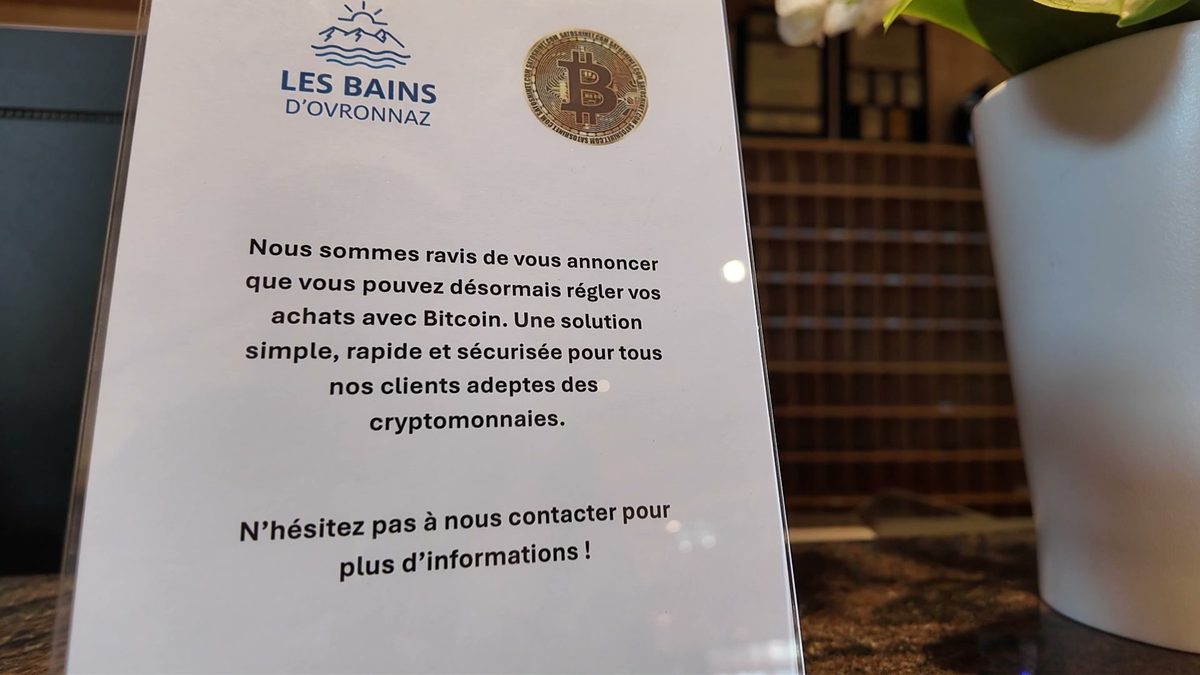
In the evening, at the Bains d'Ovronnaz, a notice at reception announced that you could now pay for your purchases in bitcoin. I paid my CHF 199 bill with 230,434 sats, in a few seconds. That was in 2025: since then, I haven't found any public confirmation that it's still possible, and the establishment isn't on BTC Map. Check before you go.
The next day, 400 kilometres to Lugano, the city of Plan ₿. At the market, I asked at several stalls whether I could pay in bitcoin. No, no, not for now. Then a "sì", and I left with dried mango, papaya and dragon fruit. The rest of my shopping in Lugano, I paid for in sats too: pasta, tomato sauce, salami, fruit, coffee, vegetables. And in the evening, a pizza.
At the hotel in Lugano, I was the first guest to pay in bitcoin. The receptionist wanted to print the receipt, we tested it together, and the hotel now has the hang of it. It's often like that: the merchant accepts it, but needs a first customer to learn.
On the third day, I headed for Graubünden. At Lake Cauma, near Flims, no bitcoin: the restaurant doesn't take it. At the end of the day, I found a cocktail bar on BTC Map that accepts it, where the region's bitcoiners meet once a month. Then a night in the Tesla, at minus 3 degrees outside.
The next day, I walked for more than an hour, lost on a ski slope, to reach a chalet run by a bitcoiner couple, in crypto since 2017. They often have guests who pay in bitcoin. Thomas summed up his philosophy for me in one sentence: "I am my own bank."
Later, a farm with its own shop, where you can pay in cash, with TWINT, or in bitcoin. Then the Rhine Falls, an interview for RTS in Biel/Bienne, and the Creux du Van. After a week, the challenge had been met.
The simplest thing is to check BTC Map, a collaborative map of the places that accept bitcoin. Its latest report, dated 18 November 2026, lists 779 places in Switzerland, including 61 ATMs and 10 exchange offices. A year earlier, there were 811: the number has even fallen slightly.
The distribution is very uneven:
| Canton | Places on BTC Map | Including ATMs and exchange offices |
|---|---|---|
| Ticino | 280, including 251 in Lugano | 10 |
| Zurich | 100 | 16 |
| Bern | 56 | 4 |
| Vaud | 23 | 7 |
| Neuchâtel | 17 | 3 |
| Zug | 15 | 0 |
| Geneva | 14 | 9 |
| Valais | 8 | 1 |
Count as of 19 November 2026, based on BTC Map data and OpenStreetMap's canton boundaries. In French-speaking Switzerland, the choice remains thin: in Geneva, of the 14 places, only 5 are businesses.
Among the big chains, only Spar stands out: around 150 of its shops are on BTC Map with Lightning, none of them in French-speaking Switzerland. The Spar in Zug has accepted Lightning since April 2025.
Also watch out for how up to date the listings are. Just over half have been verified within the year, and less than half if you set aside the Spar shops, which were verified in one go. A listed business may have stopped.
Lugano launched its Plan ₿ in 2022, with Tether, to turn the city into a hub for bitcoin and blockchain. In March 2026, the City and Tether signed a second phase, from 2026 to 2030. According to the City, more than 400 businesses accept crypto, whether bitcoin, USDT or the local currency LVGA, without saying how many take bitcoin. BTC Map lists 251 in the municipality.
That's where I was able to do real shopping in bitcoin. And Lugano is one of the few public authorities where you can pay your bills in bitcoin: the City's taxes, fees and fines can be paid in bitcoin, on the blockchain or via Lightning. It's Bitcoin Suisse that collects the payment, for a 1% fee, and converts it straight into francs. The canton of Zug has offered the same thing for taxes since 2021, up to CHF 1.5 million per bill.
Every autumn, the city also hosts the Plan ₿ Forum, whose fifth edition took place in October 2026. As for the statue of Satoshi Nakamoto, which I had eventually found at the far end of the park, it was thrown into the lake in August 2025, repaired and unveiled again in October 2025, then vandalised again in April 2026.
In Switzerland as elsewhere, small bitcoin payments almost always go through Lightning, Bitcoin's fast payment network. The price stays displayed in francs: it's the merchant's app that converts it into sats at the moment of payment.
To understand how much your sats are worth in francs, and to work it out in your head, I've written a separate guide: how much is a satoshi in Swiss francs.
For a private individual, paying in bitcoin amounts to disposing of your bitcoins. According to the Federal Tax Administration's working paper, buying and selling bitcoin is treated as a currency transaction: any gain is a private capital gain, exempt from tax, and a loss isn't deductible. The only exception is professional trading. I explain it all in my guide to taxes and bitcoin in Switzerland.
For the merchant, bitcoin is just a means of payment: VAT is calculated and declared in francs, and the invoice must show the price and the VAT in francs.
The choice is thin: BTC Map lists 14 places in the canton, only 5 of them businesses, the rest being ATMs and exchange offices. Open the map before you go out, and look at the date of each listing's last verification.
Yes, with some public authorities. The canton of Zug has accepted bitcoin for taxes since 2021, and the city of Lugano for its taxes, fees and fines, in both cases through Bitcoin Suisse, with a 1% fee. Elsewhere, check with your municipality.
No. SBB ticket machines let you buy bitcoin, but not pay for a ticket with it.
No, any Lightning wallet will work. During my tour, I was using Wallet of Satoshi. Some Swiss apps let you do it as well.
Around twenty payments filmed: where it works, where it falls down, which wallet to use.
Platforms, fees and counters: the guide to making your first purchase.
App, platform, counter: how to get francs, and at what price.
To find out how many sats your francs are worth before you pay: the Bitcoin converter.
Follow MartinBTC: YouTube · X · Instagram · TikTok
Running a Bitcoin-focused project or channel? Let's talk.