
Living unbanked in Switzerland
A year without a traditional bank: neobanks, TWINT, a crypto IBAN and the limits.
App, platform, counter or private buyer: how to turn your bitcoins into francs, what it really costs and what your bank may ask you.
Buying bitcoin in Switzerland has become simple. Selling it and getting francs into your account is another story: the fees are less visible, processing times vary, and your bank may ask you questions when the money arrives.
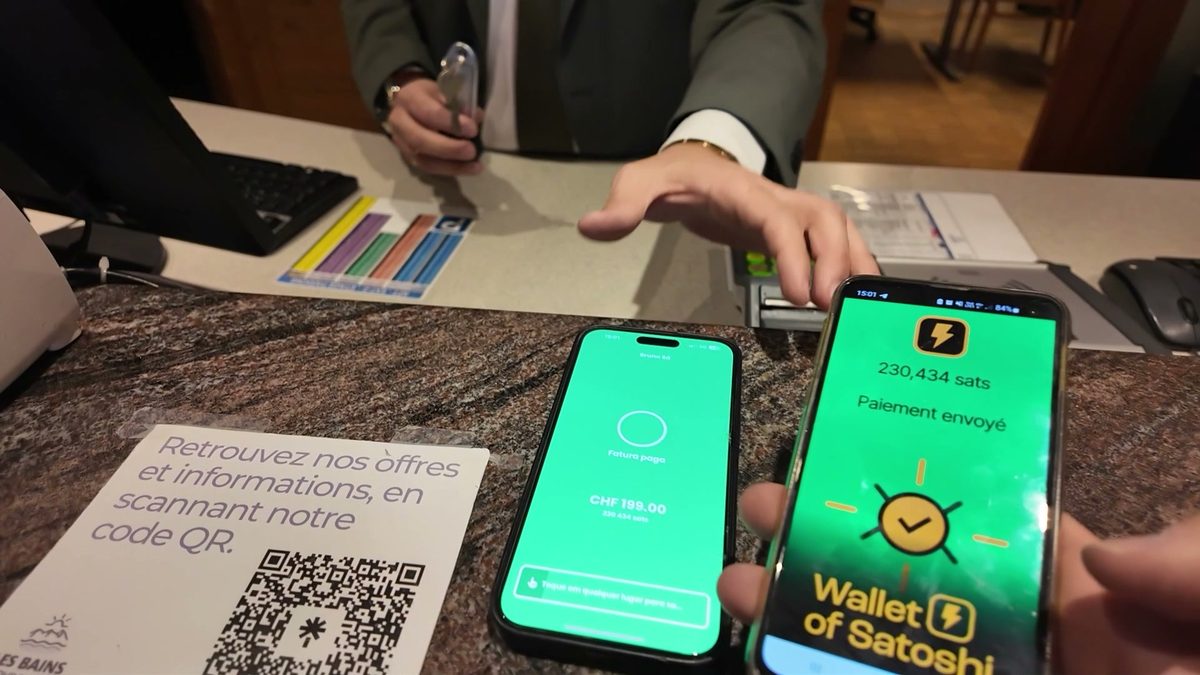
During my Swiss Bitcoin Tour, I lived for a week in Switzerland paying only in bitcoin. At the Bains d'Ovronnaz, in Valais, for example, I paid my CHF 199 bill with 230,434 sats, without selling anything beforehand. But for rent, an invoice or a project, you often have to go through Swiss francs.
Here are the ways to sell your bitcoins in Switzerland, what they really cost, and the pitfalls to avoid.
Information checked on 19 November 2026 on the official websites of the services mentioned. Prices change often: check the quote before each transaction. Transparency: Mt Pelerin is a partner of my video series on El Salvador, and SwissBorg was a partner of my Swiss Bitcoin Tour, without paying me any money. Their prices are presented here in the same way as those of the other services.
In short: to get francs into your account, Swiss apps like Mt Pelerin and platforms like Kraken do the job, with fees of around 1% or less. Always compare the final amount, spread included. To walk away with banknotes, the Rex Change counter in Geneva charges from 6 to 2.5% depending on the amount. In every case, expect to prove your identity from CHF 1,000, and to show that the wallet your bitcoins are sent from really is yours.
There are five main ways to turn your bitcoins into francs: a Swiss app, an exchange platform, a counter, an ATM or a private buyer. This table sums up the fees published by each service, excluding the spread when no figure is given for it.
| Service | You receive | Published selling fees | Identity |
|---|---|---|---|
| Mt Pelerin (Bridge Wallet) | A free transfer to your IBAN | 0% up to CHF 500 a year, then from 1.3% to 0.6% depending on your volume | No verification up to CHF 999 over 30 days |
| Kraken | A SIC transfer, CHF 1 | 1% for an instant sale, 0.40 to 0.80% on Kraken Pro | Verified account |
| SwissBorg | A withdrawal in francs, 0.10% (CHF 5 to 110) | 0.99%, plus an unquantified spread | Verified account |
| Relai | A transfer to your IBAN | 1%, plus an unquantified spread | Required |
| Yuh | Your Yuh balance | 1% | Yuh account |
| Revolut | Your Revolut balance | 1.49% with the Standard plan | Revolut account |
| Rex Change, Geneva | Cash or a transfer | From 6% to 2.5% depending on the amount | From CHF 1,000 |
| Peach, peer-to-peer | The buyer pays you directly | 0% for the seller, excluding network fees | Sellers restricted since September 2026 |
| Värdex ATMs | CHF 100 notes | Commission included in the rate, not published | Cash limited to CHF 1,000 over 30 days |
Three notable absentees: at Coinbase, the Swiss franc isn't offered; Bitstamp has no franc balance and converts your CHF at its own rate; and Bity no longer offers online selling to individuals, only a brokerage service from CHF 100,000.
I use Bridge Wallet every day, so it's the solution I know best. With Mt Pelerin, you sell directly from the app or from their website, in on-chain bitcoin or in sats via Lightning. The francs arrive in a bank account in your name, or in the personal IBAN account that Mt Pelerin can assign to you.
As for fees, the first CHF 500 sold each year is free, 1,000 if you were referred. After that, the rate depends on your cumulative volume over the year: 1.3% between CHF 501 and 5,000, 1.1% up to 50,000, then less. Careful: the rate applies to the whole transaction. The transfer within Switzerland is free, and Mt Pelerin says it takes no spread on the rate. The Bitcoin network fees are still yours to pay. Mt Pelerin's official pricing
Without identity verification, you can sell up to CHF 999 over a rolling 30-day period. The minimum is CHF 50, with none for the personal IBAN, and the maximum is CHF 100,000 per sale. Transfers go out Monday to Friday, and the money usually arrives the same day. Once the transfer has started, there's no cancelling it.
Other Swiss apps let you sell to your IBAN. Relai takes 1%, plus a spread it doesn't quantify. Pocket only allows it if you've already bought there.
The principle: you send your bitcoins to your account, you sell, then you withdraw your francs to your bank. The bank account must be in your name, the same as on the platform.
Kraken sends your francs by SIC transfer for CHF 1, usually the same day. An instant sale costs 1% plus a spread. On Kraken Pro, the trading interface, first-tier fees drop to 0.40% if your order waits in the order book, and 0.80% if it executes straight away. Kraken's official fee schedule
SwissBorg takes 0.99% on the exchange, plus a spread it doesn't quantify, then 0.10% to withdraw your francs, with a minimum of CHF 5 and a maximum of 110. SwissBorg's pricing policy
Yuh and Revolut also let you sell in the app, for 1% at Yuh and 1.49% at Revolut on the Standard plan. But at Yuh, you can only sell bitcoins bought at Yuh: the app doesn't accept transfers from an external wallet.
Would you rather walk away with banknotes, and have someone in front of you? Rex Change, at 29 bis, rue de Berne in Geneva, buys your crypto at the counter, no appointment needed, 7 days a week, from 10am to midnight. A transfer in francs, euros or pounds is also possible.
The commission falls as the amount rises: 6% up to CHF 999, 5% from CHF 1,000 to 9,999, 4% from CHF 10,000 to 24,999, 3.5% from CHF 25,000 to 49,999, 3% from CHF 50,000 to 99,999 and 2.5% from CHF 100,000. ID is requested from CHF 1,000, and the exchange office checks at its branch that the wallet your bitcoins are sent from really is yours. How Rex Change works, and its fees
It's expensive for small amounts, but it's the simplest way to get cash.
Värdex ATMs, more than 80 of them in Switzerland, also buy your bitcoins for CHF 100 notes, up to a limit of CHF 1,000 over 30 days. Their commission is included in the rate and isn't published: compare the displayed rate with the market rate before confirming. SBB (Swiss Federal Railways) ticket machines, on the other hand, sell bitcoin but don't buy it back.
On peer-to-peer exchange apps, you sell directly to a buyer, who pays you by bank transfer or by another agreed method. In principle, the bitcoins are locked in escrow until you confirm you've received the money.
Peach, a Swiss app, charges its 2% fee to the buyer: the seller only pays the network fees. But since 1 September 2026, following a regulatory review in Switzerland, only sellers with a long, trusted track record can sell. Bisq, RoboSats and HodlHodl also work peer to peer, with fees ranging from 0.2% to just over 1%.
It's the freest option, but the one that requires the most care. Never release your bitcoins before you've seen the money arrive in your account: a screenshot of a transfer proves nothing.
The real cost of a sale is the sum of several things: the transaction fees, the spread between the buying and selling price, the withdrawal fees to your bank and the Bitcoin network fees to send your bitcoins. That's the list PostFinance gives, and it's the right one.
On a sale of CHF 3,000, 1% in fees is CHF 30. 6% is CHF 180. And a 1% spread that nobody displays costs exactly as much as a 1% commission. Hence the only question that matters: how many francs arrive in your account for a given amount of bitcoin?
To send your bitcoins to the service, you also pay the network fees. If the service accepts Lightning, as Mt Pelerin does, these fees become minimal.
In Switzerland, the FINMA Anti-Money Laundering Ordinance requires your identity to be verified as soon as a crypto transaction, or several transactions that appear to be linked, reach CHF 1,000, when you don't have a lasting business relationship with the provider. For cash payments, the provider must even technically prevent this threshold from being exceeded over 30 days.
The provider must also check that the wallet your bitcoins come from really belongs to you. Depending on the service, you sign a message with your wallet, or you demonstrate it in person at a branch.
As for your bank, a large sum arriving from a crypto platform can trigger questions: the Anti-Money Laundering Act requires your bank to clarify unusual transactions. Keep your purchase and sale statements, and use a bank account in the same name as your account on the platform. That settles most questions.
Good news for most private individuals: in Switzerland, the gain you make by selling your bitcoins is a private capital gain, exempt from tax. It only becomes taxable if the tax authorities consider you a professional trader, for example if you trade a lot, short term or with borrowed money. The francs you get back, for their part, are part of your wealth on 31 December, just as your bitcoins were before. I've covered it all in detail in my guide to taxes and bitcoin in Switzerland.
For small amounts, yes: at Mt Pelerin, up to CHF 999 over 30 days without verification, and some peer-to-peer exchange apps don't ask for anything. From CHF 1,000, expect to have to prove your identity, and splitting your sale changes nothing: the law specifically targets linked transactions.
At Mt Pelerin and at Kraken, a SIC transfer usually arrives the same day, on working days. At the counter, you leave with the banknotes. If you send your bitcoins on the main blockchain, add the time it takes to confirm the transaction.
At the Rex Change counter, rue de Berne, for cash or a bank transfer, 7 days a week. Otherwise, from anywhere in Switzerland, with an app or a platform that transfers the francs to your account.
Generally, no: for a private individual managing their private wealth, the gain is exempt. It becomes taxable if the tax authorities consider you a professional trader. The francs you get are part of your wealth on 31 December.
A year without a traditional bank: neobanks, TWINT, a crypto IBAN and the limits.
What a wallet really contains, and what it doesn't.
No TWINT at Revolut: why, and the solutions that work.
To find out what your bitcoins are worth in francs before you sell: the Bitcoin converter.
Follow MartinBTC: YouTube · X · Instagram · TikTok
Running a Bitcoin-focused project or channel? Let's talk.