
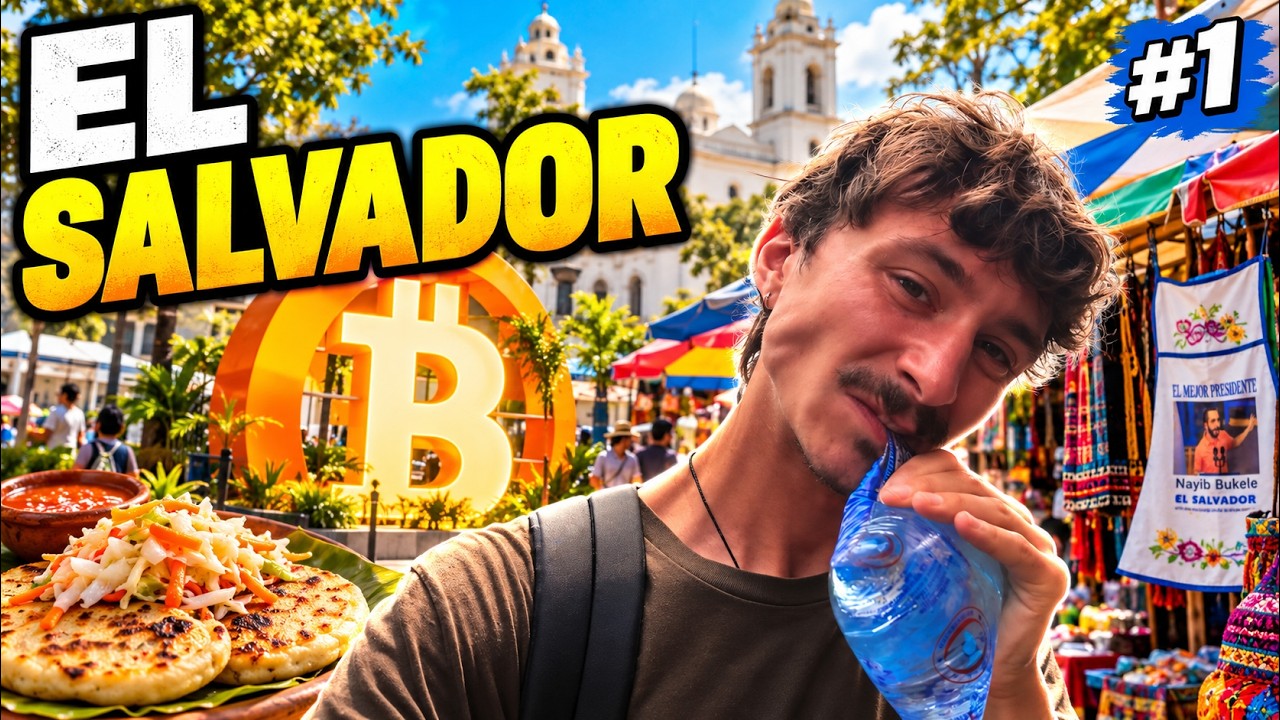
Travelling in El Salvador
My two-week itinerary, the journeys, the real prices and my tips.
Two weeks in El Salvador in May 2026, by day and by night: what has changed, the real figures, the other side of the state of exception and my advice.
Ten years ago, El Salvador was one of the most dangerous countries in the world. In 2015, around 6,650 homicides were recorded there, or 103 per 100,000 inhabitants. That same year, Switzerland had fewer than one per 100,000.
In May 2026, I spent two weeks there. First alone in San Salvador, then with Adriana on the Ruta de las Flores, in Berlín, in Suchitoto and all the way to El Zonte, on the coast. I walked around the historic centre, took Ubers at night, drove to the sea at night, and asked almost everyone the same question: what was it like before?
Here's what I saw, what the figures say, and what you need to know before you go. Without rose-tinted glasses, and without repeating the clichés of ten years ago.
In short: for a traveller, the El Salvador of 2026 no longer has much in common with the gang-ridden country of the 2010s. According to official figures, the homicide rate fell from 103 per 100,000 inhabitants in 2015 to 1.3 in 2025, and the United States puts the country at the lowest risk level. The things to watch out for lie elsewhere: petty theft, earthquakes and volcanoes, sea currents, roads at night, and a state of exception that has given law enforcement sweeping powers since 2022.
For years, the country lived under the thumb of the maras, gangs such as MS-13 and Barrio 18. Their main weapon was the renta: a protection racket imposed on shopkeepers, bus drivers and sometimes ordinary families. Anyone who didn't pay risked their life, or saw their business go up in smoke.
Over there, everyone has a story. An Uber driver told me that one evening he had fallen asleep on a minibus. When he woke up, he was in a neighbourhood he didn't know, surrounded by tattooed gang members. A friend of mine got married in El Salvador before Bukele: there were bodyguards everywhere, and the guests moved around under escort. As for me, I came alone, with nobody to protect me. The change struck me as radical.
The turning point came in spring 2022. On 26 March, more than 60 people were killed in a single day, at random, in the street, on buses, in markets. The next day, at the request of President Nayib Bukele, the Assembly voted through the state of exception, and the army and the police went to war against the gangs. The state of exception is still in force.
I spent my first day alone in the historic centre of San Salvador, in front of the National Palace and in the streets around the Mercado Central. What I said to camera that day sums up the atmosphere well: it was super peaceful, honestly. And every time I caught someone's eye, I got a smile.
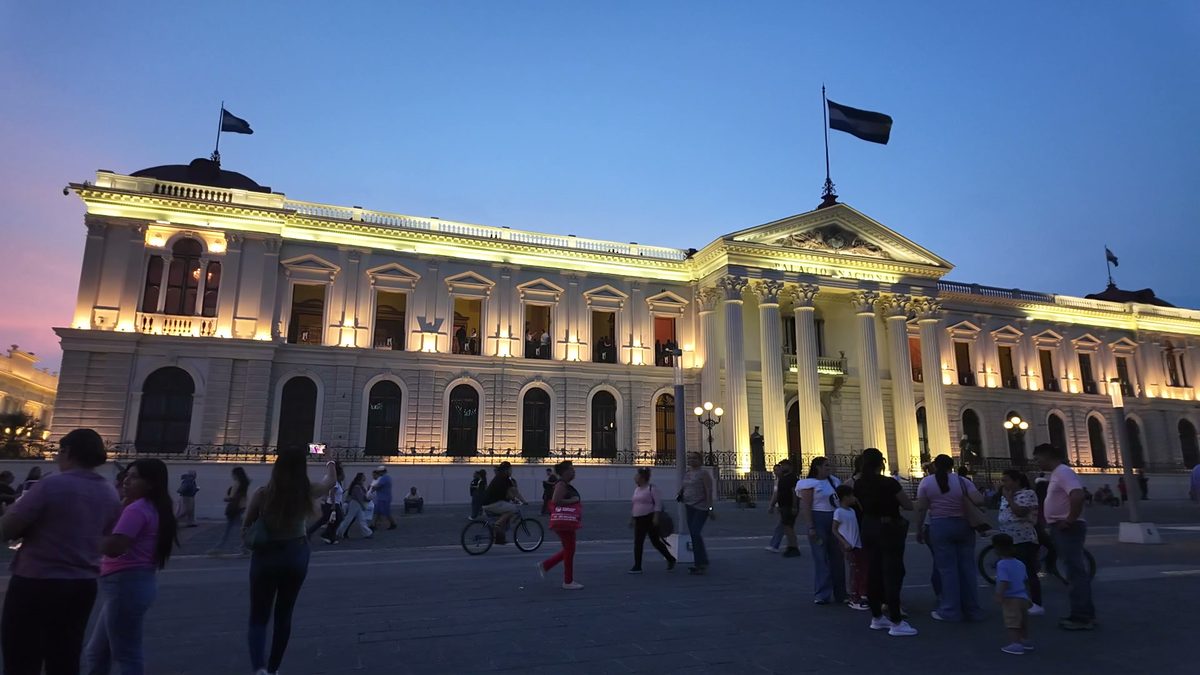
Near the Mercado Central, I asked a taxi driver whether there were any areas to avoid. His answer: "Everything's calm. There's security, soldiers, police." Then: "When Don Bukele came, he sorted everything out. Now we live in peace, we go out at midnight, we don't pay the renta any more."
A vendor at the Ex Cuartel market added a caveat, and it's an important one: as soon as you reach the outskirts, the scenery changes. But, he added, these days you can go anywhere without any trouble. I saw it for myself: you only have to stray a little from the renovated streets for the city to look less pretty straight away. Less pretty doesn't mean dangerous. Poverty, though, didn't disappear with the gangs.
It's at night that the difference shows most. I took Ubers at night in San Salvador, enjoyed a village festival one evening in Ataco, and drove to El Zonte at night. In Berlín, I was told about a young woman who gets up at 4 in the morning and makes the whole journey in the dark to get to university.
All the accounts pointed the same way. Andrés Posada, a Salvadoran who works in Bitcoin media, explained to me that you can now go anywhere without feeling that fear. Adriana, who is Peruvian, was surprised to find a level of safety in El Salvador that doesn't exist in Peru, right down to one detail: here, cars stop to let pedestrians cross. And Mike, an American I met in El Zonte, told me: "Every single person I run into has got a smile. No gang."
What I saw is two weeks of experience. The figures cover the whole country, and ten years.
| Year | Homicides | Per 100,000 inhabitants |
|---|---|---|
| 2015 | about 6,650 | 103 |
| 2019 | 2,390 | 36 |
| 2022 | 495 | 7.8 |
| 2023 | 154 | 2.4 |
| 2024 | 114 | 1.9 |
| 2025 | 82 | 1.3 |
Sources: annual round-ups by InSight Crime and official government figures reported by El Mundo. For 2026, the Minister of Security was reporting 61 homicides as of 16 November. For comparison, in 2025 France was at around 1.4 per 100,000 inhabitants (975 victims according to the Ministry of the Interior) and Switzerland at around 0.6 (55 homicides according to the Federal Statistical Office).
One clarification is needed: these figures are the Salvadoran government's. According to InSight Crime, the official count has not applied the regional standard since 2019. In particular, it leaves out people killed by the police and presented as gang members, deaths in prison and bodies found in clandestine graves. In 2023, the police's daily reports thus added up to 194 deaths, against 154 in the official tally. Even the harshest critics don't dispute the trend, but comparing with France or Switzerland to one decimal place makes little sense.
You can't talk about safety in El Salvador without talking about its price. Since 27 March 2022, the state of exception has suspended several constitutional guarantees. According to Swiss and Belgian travel advice, it notably allows a suspect to be held for up to 15 days, searches to be carried out without a warrant and gatherings to be restricted. The Assembly has extended it 56 times, most recently in October 2026.
According to the government, more than 93,000 people have been arrested since 2022. Nayib Bukele has acknowledged that around 8,000 of them had been released. Human rights organisations denounce arbitrary arrests and mass trials: Human Rights Watch quotes a public defender who had ten minutes for 102 defendants. They also count hundreds of deaths in custody, between 454 and 582 according to the NGOs, figures that the government does not publish and that cannot be verified. Amnesty International considers that these practices could amount to crimes against humanity.
I didn't visit any prisons and I don't judge what I haven't seen. I'm reporting what I saw in the street. Both realities exist at the same time: Salvadorans getting their lives back, and families waiting for news of an arrested relative.
For a traveller, in practice: always carry ID, or at least a copy of your passport, and expect checks. Stay out of politics: Switzerland points out that any political activity is forbidden for foreigners. France even advises covering up tattoos.
A safer country isn't a risk-free country. Here are the risks that really matter in 2026.
The United States has rated El Salvador at level 1 out of 4 since April 2025: "normal precautions", the lowest level. In the same ranking, France is at level 2, because of the terrorism risk. The other countries remain more cautious.
They all acknowledge the improvement. They all also point out the ordinary risks and the special framework of the state of exception. Read your own country's advice page before you leave: it changes.
In the historic centre and the lively neighbourhoods, yes: I did it, and the squares were full of families. Official advice remains cautious about getting around at night, especially outside towns. To get home late or to cross a neighbourhood you don't know, take an Uber.
According to official figures, the 2025 homicide rate (1.3 per 100,000 inhabitants) is of the same order as France's (about 1.4), and twice as high as Switzerland's (about 0.6). But the counting methods are not the same, and homicide is only one indicator among others. El Salvador has become a country where you can travel with peace of mind. Saying it is safer than France would be going further than the figures.
No, not for a tourist stay if you are Swiss, French, Belgian or Canadian. Official sources differ on how long you can stay: 90 days according to France, sometimes up to 180 according to Canada and the United Kingdom. The safe rule: check with the embassy of El Salvador before you leave.
It depends where you eat. At markets, next to nothing: three pupusas and a coffee for one dollar, two bags of water for 25 cents, goat's milk milked in front of you for one dollar. In San Salvador's speciality coffee shops, a coffee costs two to three dollars. The country also welcomed more than 4.1 million international visitors in 2025, a record, and tourist services are keeping pace.
My two-week itinerary, the journeys, the real prices and my tips.
A tiny tabbouleh on the Camino, and a lesson that cost a couple their whole dinner.
A young Frenchman walks back into the night before I get the chance to offer him my bed.
Follow MartinBTC: YouTube · X · Instagram · TikTok
Running a Bitcoin-focused project or channel? Let's talk.